
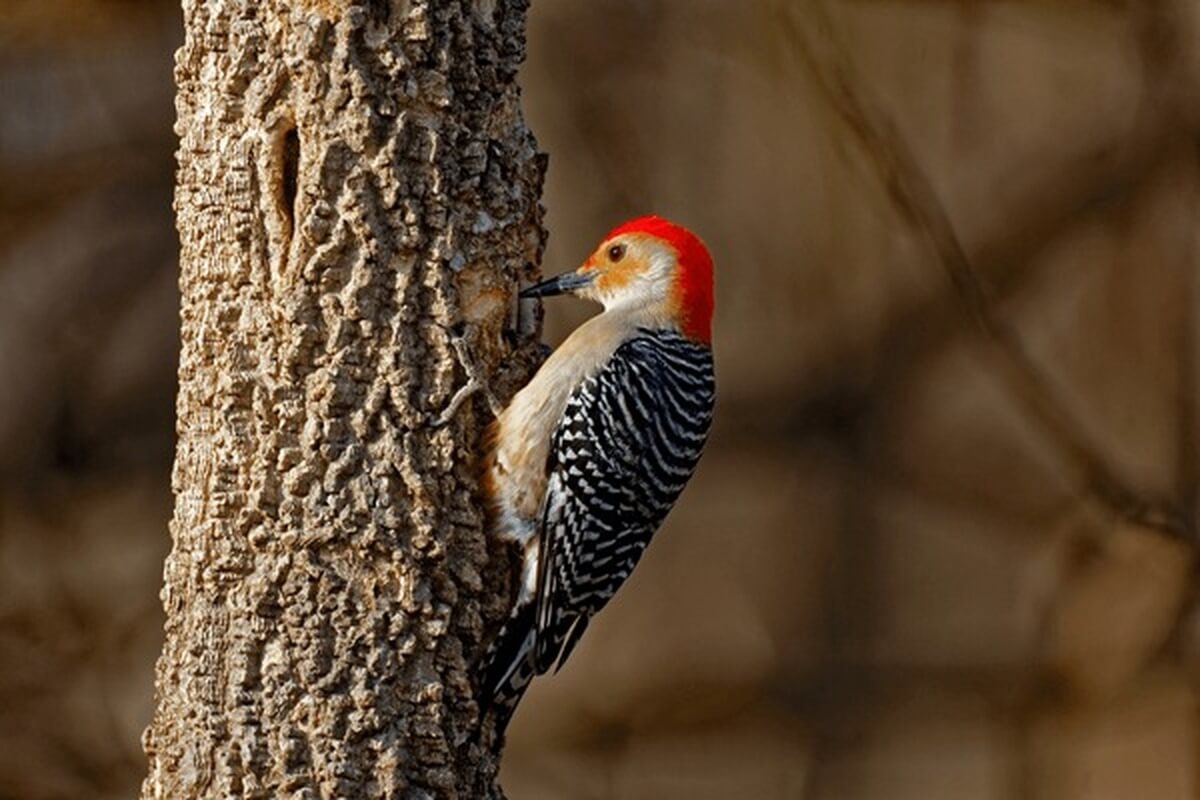
The drumming is the giveaway, but there’s a lot more going on with woodpeckers than the sound they’re famous for. Here’s what actually defines a woodpecker as a group, and what they’re really after when they’re hammering away at a tree.
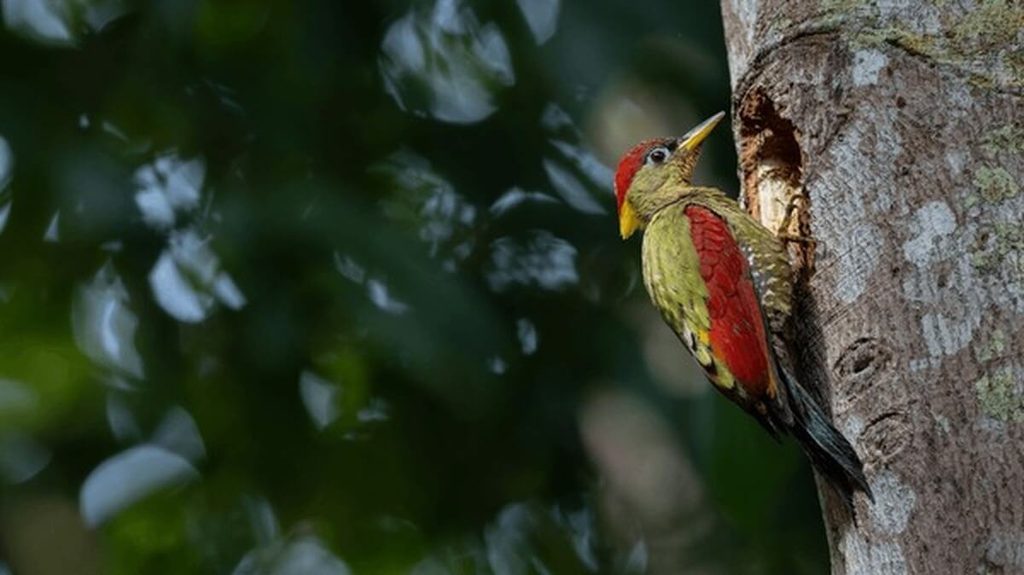
What Is a Woodpecker, Exactly?
Woodpeckers are a family of birds (Picidae) defined by a set of physical adaptations built specifically for pecking into wood — something almost no other bird does regularly. A few features set them apart: a reinforced, chisel-shaped bill built to absorb repeated impact, a skull structure and neck muscles adapted to withstand that impact without injury, stiff tail feathers used as a brace against tree trunks while climbing and pecking, and zygodactyl feet — two toes forward, two back — that give them an unusually strong grip on vertical bark surfaces most birds couldn’t cling to at all.
Beyond the physical toolkit, woodpeckers are known for two distinct sounds: drumming, a rapid, non-vocal hammering used for communication (marking territory or attracting a mate) rather than feeding, and pecking or excavating, a slower, more deliberate action used to dig into wood for food or to create a nest cavity.
Do Woodpeckers Eat Ants?
Yes — and this is one of the more surprising, underappreciated facts about woodpecker diet. As a group, woodpeckers eat far more ants than most other birds do, and for some species, ants make up an enormous share of the diet: a Pileated Woodpecker’s diet, for example, can be as much as 50% ants during parts of the year. Northern Flickers, a common woodpecker species, are especially notable for this — unlike most woodpeckers, they frequently feed on the ground rather than on tree trunks, specifically to reach ant colonies, and a single flicker has been recorded eating several thousand ants in one feeding session.
Woodpeckers extract ants using a long, sticky, barbed tongue that can extend far beyond the tip of the bill — in some species, the tongue is long enough that it wraps around the inside of the skull when retracted, an adaptation almost unique to this family of birds. This tongue lets a woodpecker reach deep into ant colonies, termite galleries, or insect tunnels bored into wood, far beyond what the bill alone could access.
What Else Do Woodpeckers Eat?
Beyond ants, woodpecker diet is broadly insect-heavy but genuinely varied:
- Wood-boring beetle larvae — one of the primary reasons woodpeckers excavate into dead or dying wood in the first place; the drumming and pecking that sounds destructive is often the bird locating and extracting insects already damaging the tree
- Other insects and larvae — spiders, caterpillars, and a wide range of other invertebrates, with some species recorded eating over 40 different kinds of insects
- Tree sap — sapsuckers, a subgroup of woodpeckers, drill neat rows of shallow holes specifically to feed on the sap that wells up, and also feed on insects attracted to the sap
- Fruit, berries, and nuts, seasonally, when insect availability drops
- Suet and seed at feeders — a major reason woodpeckers are common backyard visitors, since suet in particular closely mimics the fat and protein profile of their natural insect diet
Why Woodpeckers Drum on Houses (Not Just Trees)
This is one of the most common woodpecker-related questions homeowners ask, separate from diet entirely: woodpeckers drumming on siding, gutters, or chimneys are almost always doing it for communication, not food. Metal or resonant wood surfaces on a house carry sound further and louder than a typical tree trunk, which makes them appealing for territorial drumming even though there’s nothing to eat there. Persistent pecking concentrated in one small area, rather than broad drumming, is more likely to indicate an actual insect problem in the wood underneath worth having inspected.
How Woodpecker Diet Changes by Season
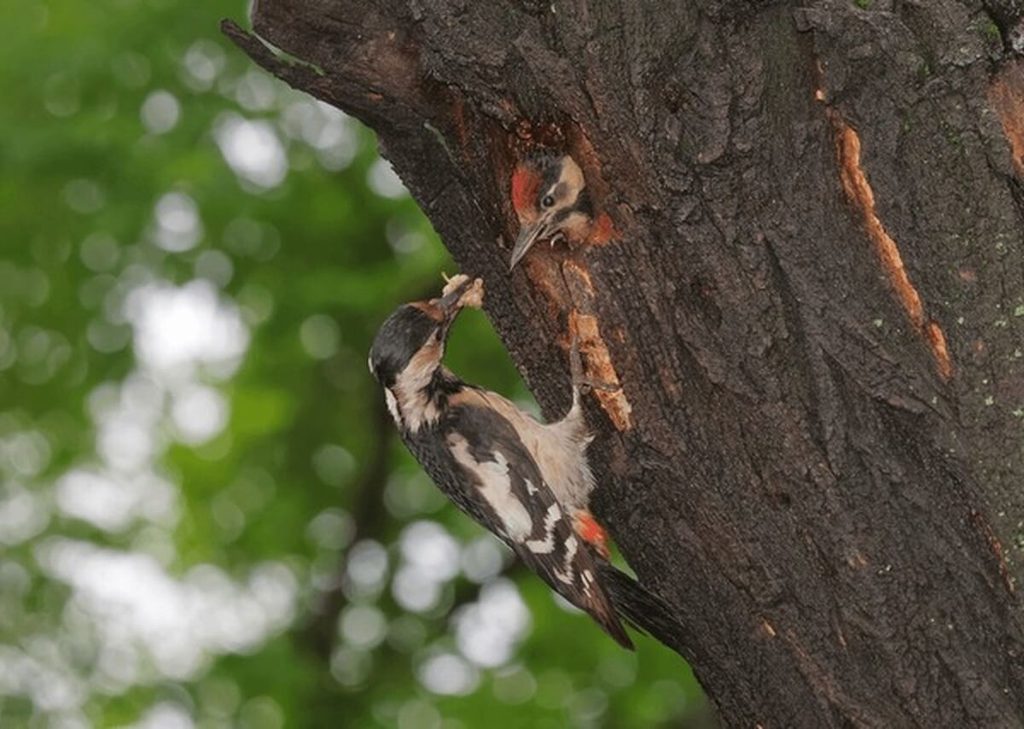
Insect availability drives most of the seasonal shift. Spring and summer, when insects (including ants) are most abundant and active, make up the peak feeding period for most woodpecker species, and this timing also lines up with breeding season, when a steady insect supply is needed to feed chicks. Fall and winter bring a shift toward more varied foraging — dormant, overwintering insect larvae hidden in bark and dead wood become a key target, alongside a greater reliance on nuts, berries, and backyard feeders (particularly suet) as insects become scarcer and harder to find above ground.
A Few Myths Worth Addressing
Myth: Woodpeckers only eat wood. Not true at all — wood itself has no nutritional value to a woodpecker; they’re after the insects living inside it, and excavating wood is a means to an end, not the food source itself.
Myth: All woodpeckers feed the same way. Not accurate — most species forage on tree trunks and branches, but Northern Flickers regularly feed on the ground for ants, and sapsuckers feed largely on sap rather than wood-boring insects, showing real diversity within the family.
Myth: Woodpecker damage to a house means the wood is rotting. Often true, but not always — sometimes it’s purely territorial drumming on a resonant surface with nothing structurally wrong underneath, so it’s worth distinguishing the type of pecking before assuming the worst.